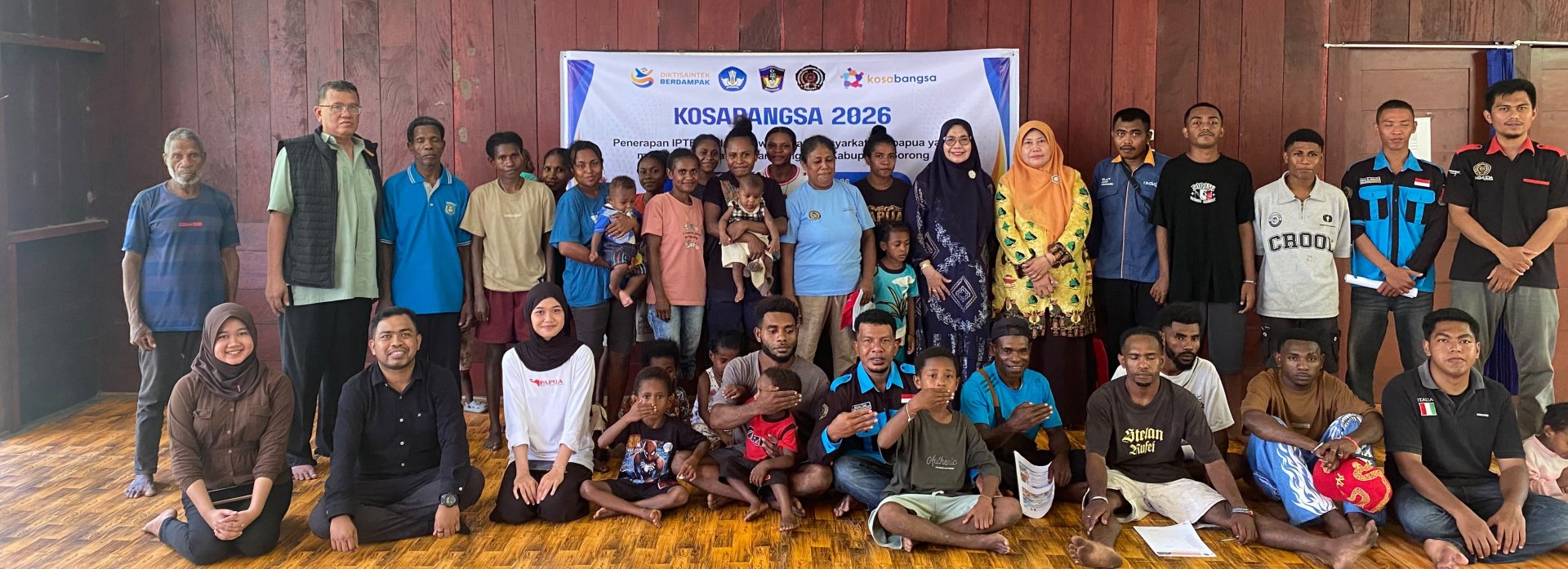
SORONG, SOUTHWEST PAPUA – Universitas Muslim Indonesia (UMI) Makassar is participating in the implementation of the 2026 Social Collaboration for Community Development Program (Kosabangsa) as a Mentoring Team. The program is funded by the Directorate General of Research and Development under the Ministry of Higher Education, Science, and Technology of the Republic of Indonesia. It aims to strengthen the contribution of higher education institutions to community empowerment through the application of science, technology, and innovation.
In implementing the 2026 Kosabangsa Program, UMI Makassar serves as the mentoring university, collaborating with the implementation team from Universitas Pendidikan Muhammadiyah (UNIMUDA) Sorong, Southwest Papua. This collaboration represents a form of inter-university synergy aimed at developing science- and technology-based solutions that align with the needs and potential of local communities. The activity is entitled “Application of Science and Technology to Realize an Independent and Creative Indigenous Papuan Community.”
The UMI Mentoring Team is led by Prof. Dr. Ir. Harlina, MP, with Prof. Dr. Ir. Rustam, M.Si. and Dr. Tentiawaru, SE., M.Si., Ak., CA. serving as members. Meanwhile, the Kosabangsa Implementation Team from UNIMUDA Sorong is led by Muh. Ishar Difinibun, S.Pi., with Ainul Amin Rahman, MT and Sofyan Muhammad as members.
UMI's involvement as a Mentoring Team plays a strategic role in providing guidance, direction, and support throughout the program implementation. This includes activity planning, the application of appropriate technology, community capacity building, and program evaluation. Such mentoring is expected to ensure that the innovations introduced not only provide short-term benefits but can also be developed and utilized sustainably by local communities.
The 2026 Kosabangsa Program emphasizes a collaborative approach between higher education institutions and communities, with local potential serving as the foundation for innovation development. Through this approach, communities are expected not merely to be beneficiaries but also to take an active role as key participants in the development process and in realizing the potential of their respective regions.
The Head of the UMI Mentoring Team, Prof. Dr. Ir. Harlina, MP, stated that UMI's participation in the Kosabangsa Program represents a concrete implementation of the university's Three Pillars of Higher Education (Tri Dharma Perguruan Tinggi), particularly in community service. According to her, higher education institutions have a responsibility to ensure that research findings, knowledge, and innovations can be directly applied to address various challenges faced by communities.
The collaboration between UMI Makassar and Universitas Pendidikan Muhammadiyah Sorong is expected to serve as a concrete step toward strengthening academic synergy, enhancing human resource capacity, and encouraging the development of independent, productive, and creative communities.
Through the implementation of the 2026 Kosabangsa Program, both universities are committed to introducing innovations that address community needs, optimizing local resource potential, and establishing sustainable community empowerment models.
This collaboration further highlights the role of higher education institutions not only as centers of scientific and technological development but also as strategic partners of communities in achieving inclusive and sustainable development, particularly in Southwest Papua.