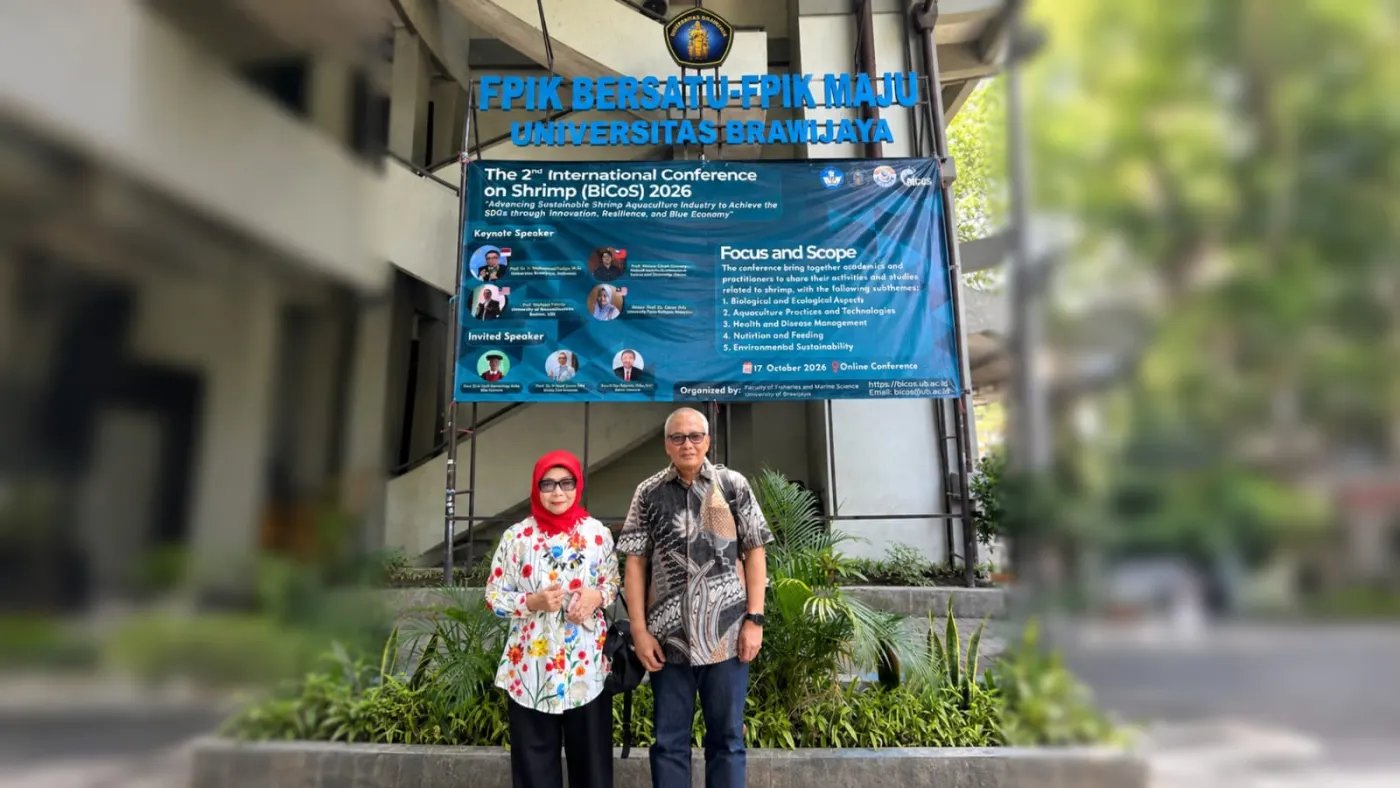
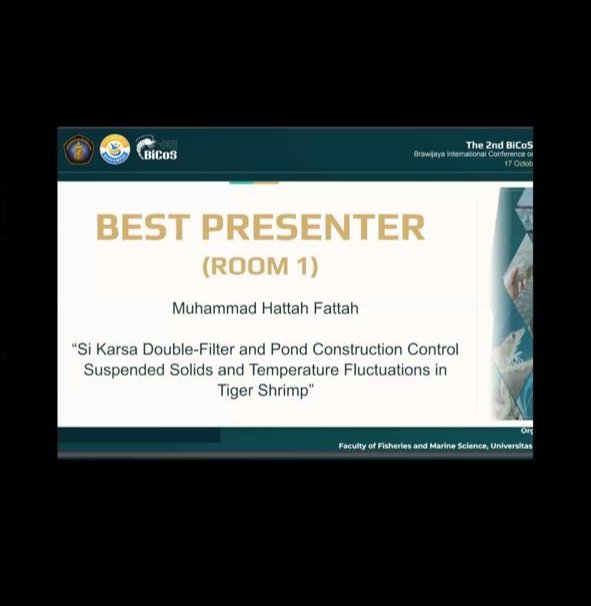
MALANG, fpik.umi.ac.id — Lecturers from the Faculty of Fisheries and Marine Science (FPIK), Universitas Muslim Indonesia (UMI), Makassar, received the Best Presenter award at the 2nd International Conference on Shrimp (BICoS) 2026, held by Universitas Brawijaya (UB) in Malang on October 17, 2026. This achievement recognizes the contributions of UMI academics in developing technological innovations with the potential to improve the quality and productivity of Indonesia’s shrimp hatchery industry.
The research team was led by Prof. Dr. Ir. Muhammad Hattah Fattah, M.S., with Dr. Ir. Ramdan Satra and Dr. Ir. Sitti Rahbiah as team members. The research conducted by the FPIK UMI lecturers received funding from the Indonesia Endowment Fund for Education (LPDP), in collaboration with the Ministry of Higher Education, Science, and Technology, through the 2026 Strategic and Priority Research Downstreaming Scheme (SINERGI).
The research, entitled “Digital Assistant for Shrimp Hatcheries,” focuses on developing digital technologies to support shrimp hatchery management, particularly in maintaining and controlling water quality. The initiative integrates the Internet of Aquaculture Things (IoAT) and Artificial Intelligence (AI) to improve the effectiveness of hatchery operations.
Through this technological approach, the research team aims to develop a system that can help detect potential problems during hatchery operations and provide solutions powered by artificial intelligence. This is expected to make shrimp post-larvae production more efficient, productive, and sustainable. Beyond technological innovation, the research also aims to develop a product with commercialization potential to support Indonesia’s blue economy.
Prof. Muhammad Hattah Fattah explained that the research was driven by the need to develop technological solutions that address real challenges in the shrimp hatchery industry.
“Our research aims to deliver technological solutions to address real challenges in shrimp hatchery operations. By integrating digital technology, artificial intelligence, and innovative water quality management, we hope to make shrimp post-larvae production more controlled, productive, and sustainable,” he said.
One of the key innovations resulting from this research is a water treatment technology called the Si-Karsa Double Filter. This technology is combined with modifications to pond construction to help maintain stable water quality and create more optimal rearing conditions for juvenile shrimp.
The innovation was developed to address challenges in implementing Pre-Grow-Out Nursery Pond technology, known in Indonesia as pentokolan, a nursery stage in shrimp cultivation. One of the main challenges at this stage is the relatively low survival rate of juvenile shrimp, with the reported average survival rate reaching only approximately 23 percent.
The nursery stage plays an important role in improving juvenile quality while shortening the rearing period during a phase when shrimp are particularly vulnerable to disease, especially after approximately 60 days of cultivation.
At BICoS 2026, the FPIK UMI research team presented its findings under the title “Si Karsa Double-Filter and Pond Construction Control Suspended Solids and Fluctuations in Temperature and Oxygen in Tiger Shrimp.” The scientific paper is planned for publication in a reputable international journal indexed by Scopus.
According to the research findings presented at the conference, the combination of the Si-Karsa Double Filter and modified pond construction reduced total suspended solids (TSS) in seawater from 14 mg/L to 9 mg/L. This reduction indicates an improvement in a water quality parameter that is important for maintaining suitable rearing conditions for juvenile shrimp.
In addition to reducing TSS, the technology was reported to maintain oxygen levels within the range of 6.5–8.0 and water temperatures between 29 and 30 degrees Celsius. These more stable water quality conditions were associated with the prevention of gill lamella swelling and bleeding, as well as disease infections in juvenile shrimp. In the trials presented, the juvenile shrimp survival rate reached 98 percent.
According to Prof. Hattah, this achievement represents an encouraging development in efforts to improve the success of shrimp nursery technology. Water quality management through an integrated filtration system and appropriate pond construction has significant potential to support juvenile shrimp health and improve their survival.
“A survival rate of 98 percent is a very encouraging achievement for the development of nursery technology. These findings indicate that water quality management through an integrated filtration system and appropriate pond construction has the potential to significantly improve juvenile shrimp health and survival,” he explained.
He further emphasized that the development of this innovation focuses not only on academic achievements and scientific publications but also on its practical application in the aquaculture industry. Therefore, technological effectiveness, ease of operation, and commercialization opportunities are important considerations in developing the Digital Assistant for Shrimp Hatcheries.
“We want to ensure that the innovations produced through our research can be implemented and deliver direct benefits to farmers. Therefore, technological effectiveness, ease of operation, and commercialization opportunities are key considerations in developing the Digital Assistant for Shrimp Hatcheries,” he added.
The Best Presenter award received by the FPIK UMI lecturers at the international conference further strengthens the role of higher education institutions in developing research-based innovations to address the needs of the aquaculture sector. Participation in BICoS 2026 also provided an opportunity to exchange knowledge and introduce the research findings to academics and researchers in the shrimp industry.
The Si-Karsa Double Filter technology is currently undergoing the patent application process through the Directorate General of Intellectual Property (DGIP), under Indonesia’s Ministry of Law. This initiative forms part of the team’s efforts to protect intellectual property and commercialize research outcomes, providing a legal basis for further development and potential commercial application.
Prof. Hattah expressed his hope that the award would motivate the research team to continue producing innovations that deliver tangible benefits to society and industry.
“This award motivates us to continue developing innovative research with meaningful impacts. We hope that our technology will go beyond scientific publications and academic forums and be adopted by the shrimp hatchery industry, contributing to the competitiveness of Indonesia’s aquaculture sector,” he concluded.
This achievement reflects the contribution of FPIK UMI lecturers to applied research that addresses industry needs. Through technological innovation in shrimp hatchery operations, FPIK UMI continues to play a role in improving productivity, strengthening the competitiveness of the aquaculture sector, and supporting the development of Indonesia’s blue economy.