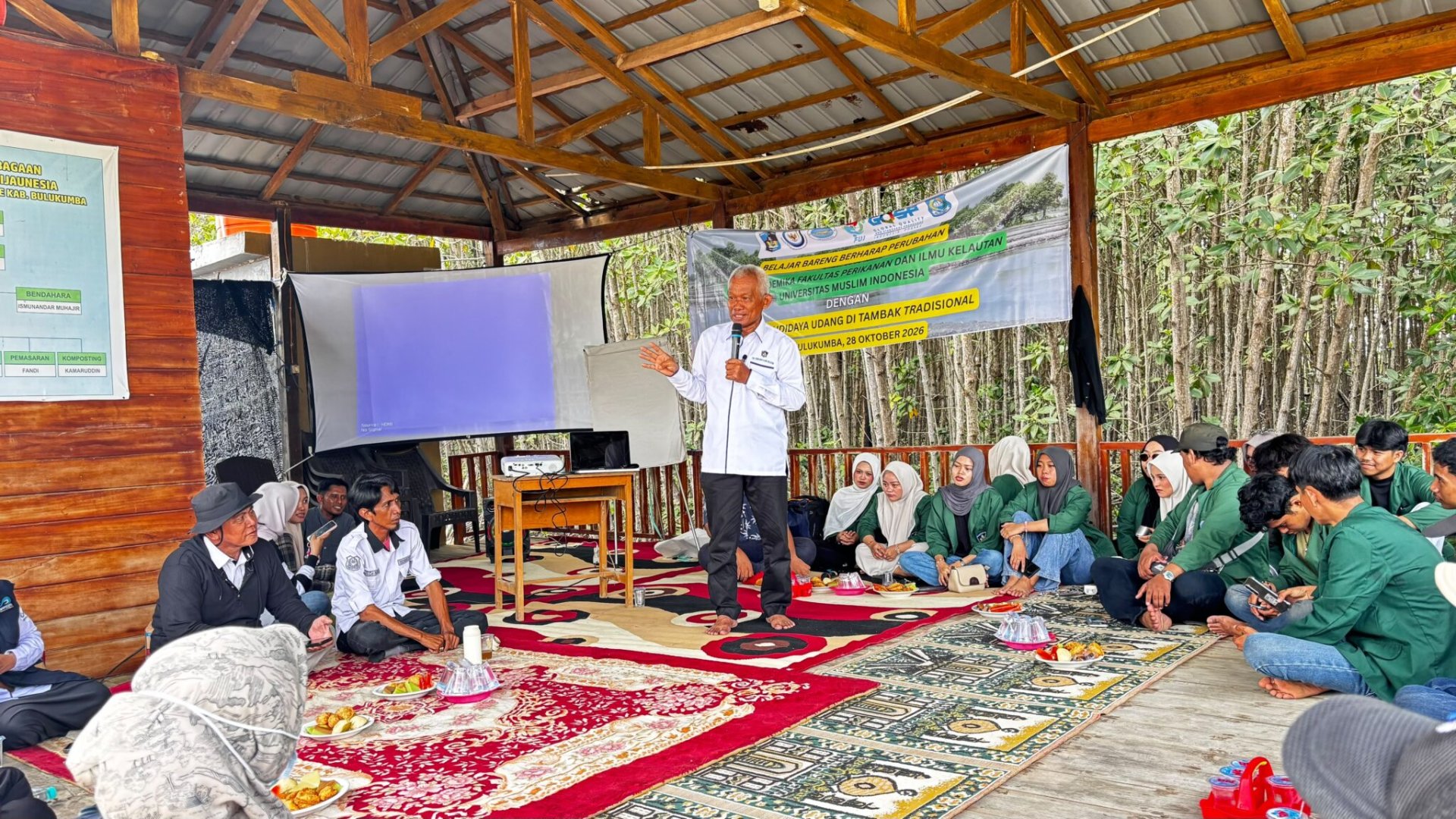
BULUKUMBA, FPIK UMI– Ir. Muhammad Saenong, MP., a lecturer at the Faculty of Fisheries and Marine Science, Universitas Muslim Indonesia (FPIK UMI), provided educational guidance on the implementation of Good Aquaculture Practices (CBIB) to strengthen fish farmers’ capacity to develop productive, safe, environmentally friendly, and sustainable aquaculture businesses.
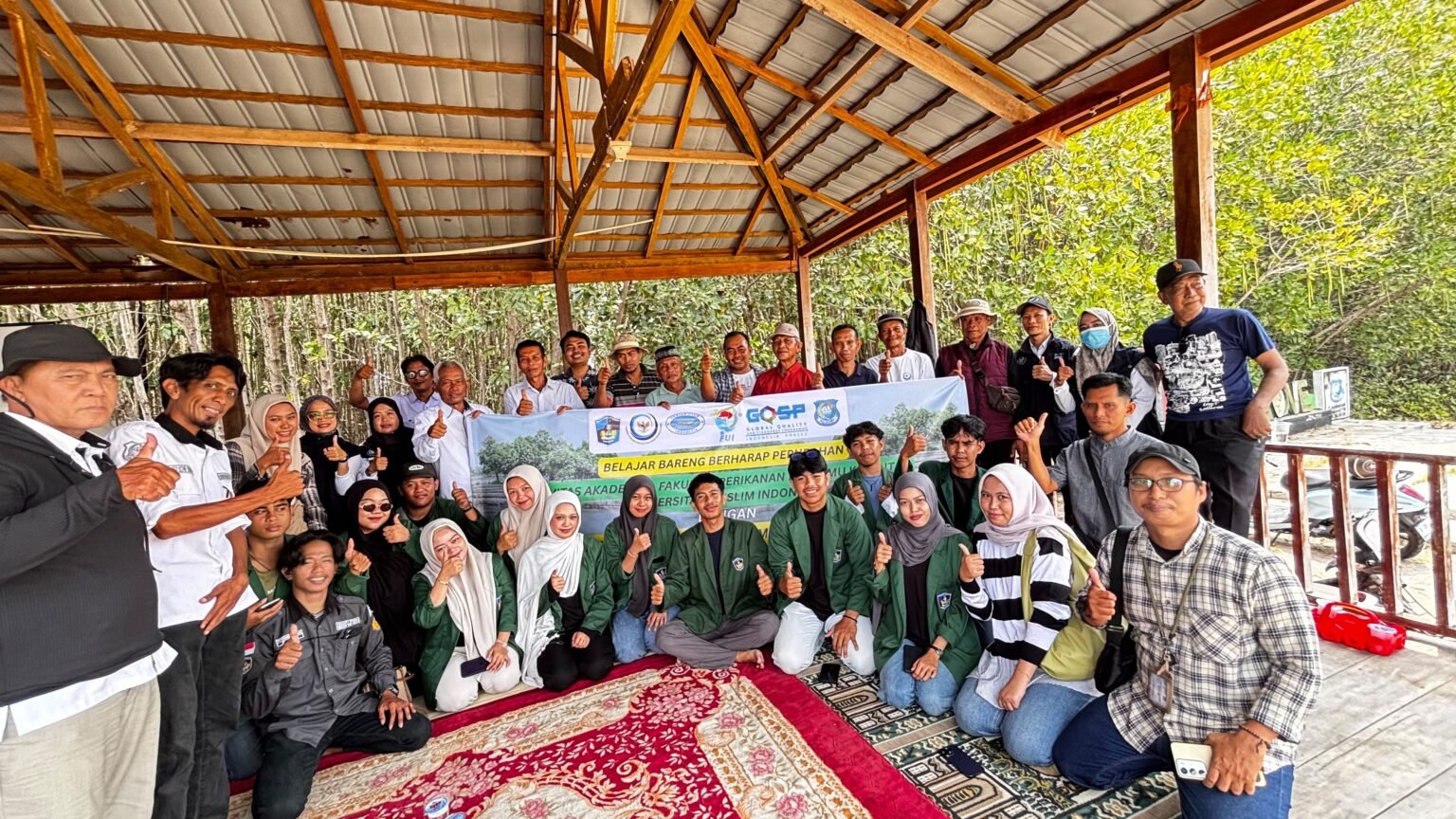
The educational activity focused on the application of CBIB principles in fish and shrimp farming, particularly in traditional pond systems commonly operated by local communities. Participants included local fish farmers, representatives of the Fisheries Agency, field fisheries extension officers, technical facilitators, environmental facilitators, business facilitators from the IISAP project in Bulukumba Regency, and fisheries students from Universitas Muslim Indonesia.
During his presentation, Ir. Muhammad Saenong explained that CBIB encompasses four main pillars: food quality and safety, aquatic animal health and welfare, environmental sustainability, and social and economic considerations. These principles need to be integrated into every stage of aquaculture production, from pond preparation and cultivation to harvest handling.
According to him, improving pond productivity does not necessarily require substantial investment in expensive technology. Farmers can adopt better aquaculture practices through simple, consistent routines, including observing fish and shrimp conditions, measuring water quality, recording farming activities, and taking appropriate action based on field observations.
These practices can be summarized in four steps: observe, measure, record, and act. Farmers should monitor aquatic animal behavior, feeding activity, water color and odor, and mortality rates. These observations can be complemented by measuring water quality parameters such as temperature, pH, salinity, and dissolved oxygen, depending on the equipment available.
In traditional pond systems, managing natural food sources, including klekap, plankton, benthos, and detritus, is also important for supporting the growth of cultured species. Therefore, the use of fertilizers and supplementary feed should be adjusted to actual needs and the pond's carrying capacity to prevent adverse effects on water quality and the surrounding environment.
The selection of high-quality seed stock from traceable sources is another important aspect of CBIB. Healthy, active, relatively uniform juveniles obtained from reliable suppliers can help reduce the risk of production failure. Acclimatization to pond water temperature and salinity should also be carried out gradually before stocking.
Aquatic animal health and biosecurity are equally important. Farmers need to recognize early signs of health problems, including reduced feeding activity, fish or shrimp appearing at the water surface, and increasing mortality. When health concerns arise, farmers should assess water quality, identify possible causes, and coordinate with fisheries extension officers or aquatic animal health personnel.
Ir. Muhammad Saenong also emphasized the importance of environmental management through proper control of water inlets and outlets, sediment management, pollution prevention, and mangrove ecosystem protection. These measures help ensure that aquaculture activities do not create adverse environmental impacts or negatively affect neighboring farming operations.
From a business management perspective, maintaining production records is essential for evaluating farming performance. Records covering seed stock sources, pond preparation, feed and fertilizer use, water quality, medication, production volume, and operating costs can help farmers make decisions based on data and lessons learned from previous production cycles.
He further encouraged farmers to improve their aquaculture practices gradually in line with their pond management capabilities. Increasing stocking density or adopting more intensive farming systems should only be considered when adequate water management, oxygen availability, disease control, and continuous monitoring can be maintained.
The implementation of CBIB is also expected to be more effective when carried out collectively through farmer groups. Coordination regarding water sources, water exchange schedules, seed selection, disease information, and harvest planning can help reduce shared risks within the same pond-farming area.
The educational material referred to Minister of Marine Affairs and Fisheries Regulation No. 22 of 2024 concerning Good Fish Rearing Practices, which serves as one of the regulatory foundations for aquaculture management that considers food safety, aquatic animal health, environmental sustainability, and business continuity.
Through this activity, Ir. Muhammad Saenong expressed his hope that farmers would not only understand the concept of CBIB but also apply it consistently in their daily operations. Support from extension officers, technical facilitators, environmental facilitators, business facilitators, and universities is essential to translate the knowledge gained into practical improvements at the pond level.
The activity highlighted that aquaculture success should not be measured solely by production volume. Harvest quality, cost efficiency, aquatic animal health, environmental protection, and the long-term resilience of farming businesses are equally important indicators.
For FPIK UMI, education on CBIB implementation represents the university’s contribution to strengthening community capacity, promoting responsible aquaculture practices, and supporting the development of a competitive and sustainable aquaculture sector.