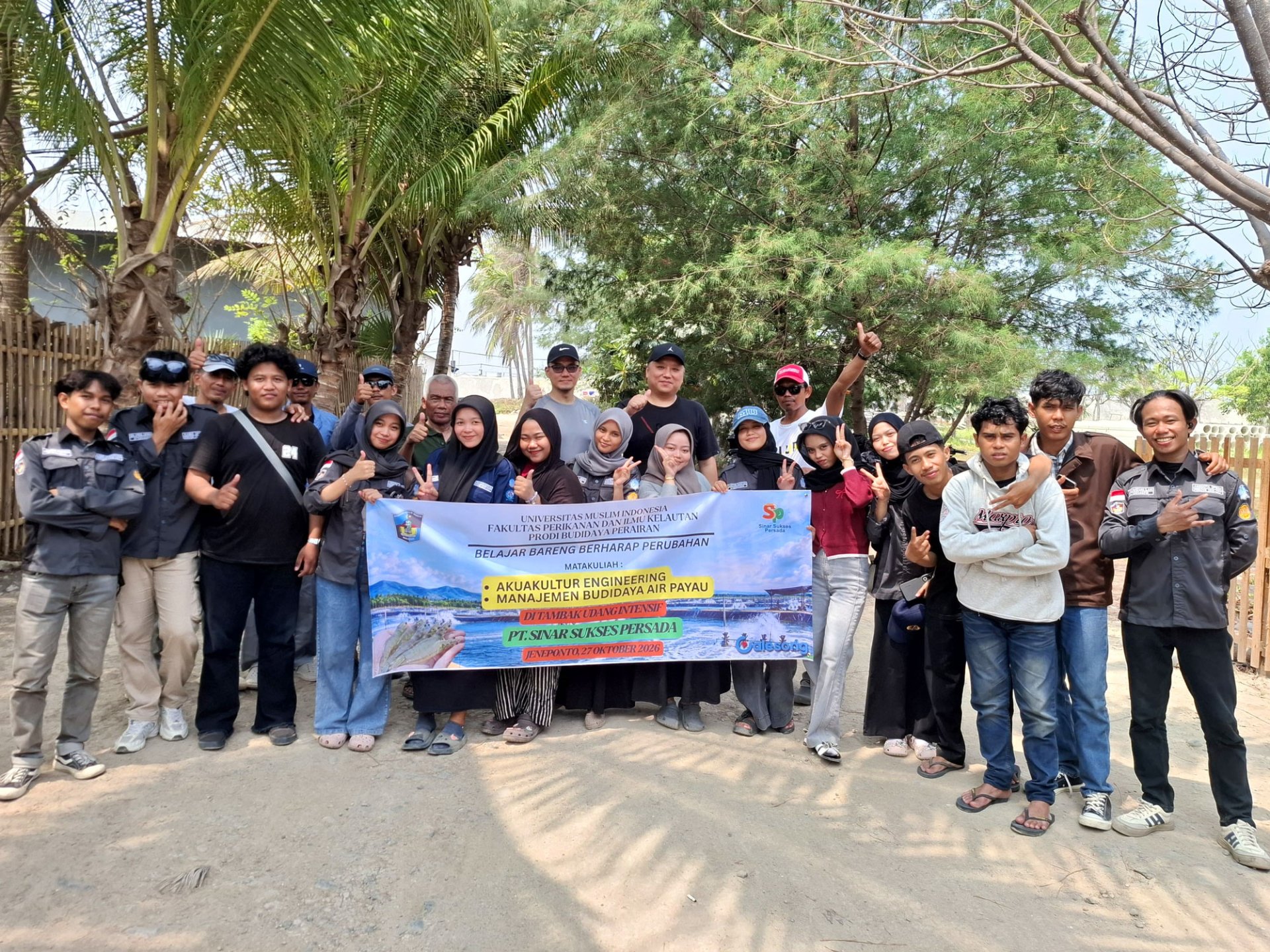
JENEPONTO, fpik.umi.ac.id — Fifteen students from the Aquaculture Study Program, Faculty of Fisheries and Marine Science (FPIK), Universitas Muslim Indonesia (UMI), Makassar, conducted a field learning visit to a vannamei shrimp farm owned by Galesong Group, PT Sinar Sukses Persada (SSP), in Jeneponto Regency, South Sulawesi, on Tuesday, October 27, 2026.
The visit involved eight female students and seven male students as part of practice-based learning designed to strengthen their understanding of the application of technology and operational management in commercial vannamei shrimp farming.
The activity supported two core courses: Aquaculture Engineering and Brackishwater Aquaculture Management. Through Aquaculture Engineering, students explored the design and construction of intensive shrimp ponds and their supporting facilities. Meanwhile, Brackishwater Aquaculture Management focused on operational procedures, from pond preparation and post-larvae stocking to cultivation monitoring and harvesting.
During approximately three hours of touring the farm complex, the students were accompanied by their academic supervisor, Ir. Muhammad Saenong, M.P., and members of the PT SSP Galesong Group operations team, Robby Arnold, Ronald Arnold, and Awal. Their guidance enabled students to observe farming operations firsthand and gain technical insights from industry practitioners.
Academic supervisor Ir. Muhammad Saenong, M.P., explained that the field visit was designed to bridge the gap between theoretical knowledge acquired in the classroom and practical applications in the aquaculture industry.
“This approach is important so that students not only understand the theory conceptually but can also observe shrimp farming operations comprehensively. We selected the Galesong Group shrimp farm in Jeneponto because it is considered a highly representative and modern aquaculture facility in South Sulawesi,” he explained.
He added that the farm is equipped with supporting infrastructure, including a seawater intake system located in an area with reportedly excellent water quality. The use of modern technology was another important aspect of the visit, particularly in relation to water quality management, minimizing the risk of disease-causing organisms, including Taura virus, and maintaining optimal farming productivity.
One of the participants, Nur Azila Abduh, a student from East Luwu, expressed her appreciation for the opportunity to learn directly from industry practitioners. She noted that the experience provided a new perspective on technological advancements and the implementation of intensive shrimp farming systems.
“This practical visit helped us compare the theories we learn on campus with actual field conditions. What we saw in practice showed much greater progress than what we had learned in the classroom. We spent three hours here, and it felt as though we gained more knowledge from touring the facility than from seven classroom sessions,” Azila said.
This field learning activity represents an effort to strengthen the competencies of FPIK UMI Aquaculture students through direct exposure to industrial practices. The experience is expected to improve their technical understanding, analytical skills, and readiness to face technological developments and challenges in modern aquaculture.
Through initiatives such as this, FPIK UMI also promotes stronger partnerships between higher education institutions and the business and industrial sectors. Sustainable collaboration is expected to support educational quality and produce competent, adaptable graduates who are ready to contribute to the development of the fisheries and marine sectors.