TAKALAR, FPIK UMI — The Faculty of Fisheries and Marine Science (FPIK), Universitas Muslim Indonesia (UMI), Makassar, continues to promote productive business development based on local resources through community service initiatives. This time, a team of FPIK UMI lecturers conducted an educational session on integrating tilapia farming with free-range chicken raising for members of the Village-Owned Enterprise (BUMDes) in Sanrobone Village, Takalar Regency, South Sulawesi, on Thursday, October 22, 2026.
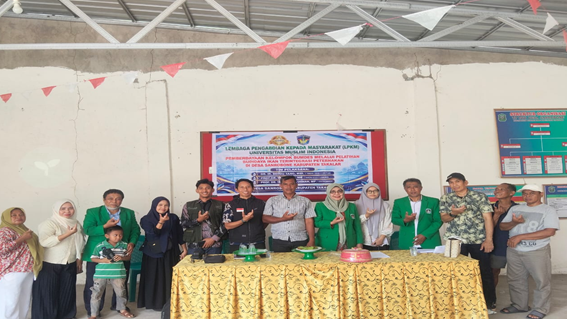
The activity, entitled “Empowering BUMDes through Integrated Tilapia Farming and Free-Range Chicken Raising in Sanrobone Village, Takalar Regency,” was held at the Sanrobone Village Office and attended by 20 participants. The program aimed to introduce alternative approaches to developing fisheries and livestock businesses that could increase productivity, expand economic opportunities, and strengthen village economic independence.
The community service team was led by Dr. Ir. Beddu Tang, M.Si., with Prof. Dr. Ir. Jayadi, MP and Prof. Dr. Ir. Harlina, MP as team members. Two students also participated in the activity as part of their field-based learning and the practical application of scientific knowledge within the community.
The educational session received support from the Sanrobone Village Government, represented by Village Secretary Suardi, and the BUMDes management, represented by BUMDes Secretary Syamsuddin. Their participation highlighted the importance of collaboration among higher education institutions, village governments, and local economic organizations in developing productive businesses based on regional potential.
Integrating Fisheries and Livestock to Create Productive Business Opportunities
During the educational session, the lecturers introduced opportunities to develop tilapia farming alongside free-range chicken raising as an alternative business diversification strategy for BUMDes. This approach aims to optimize the use of local resources, increase production value, and create opportunities for new business units at the village level.
Tilapia is a freshwater fish species with considerable potential for development through well-planned aquaculture systems. Meanwhile, free-range chickens can serve as a complementary livestock commodity with the potential to diversify household and village business income.
The integration of these two sectors can be developed through coordinated production planning while meeting the specific technical requirements of each commodity. When properly designed, this approach may also support circular economy principles by improving resource efficiency and promoting responsible waste management.
However, implementation requires careful planning, particularly regarding pond water quality, poultry housing sanitation, waste management, fish and livestock health, and an assessment of production costs and potential revenue. These considerations are essential to ensuring that integrated farming operates safely, productively, and sustainably.
Strengthening BUMDes Capacity through the Application of Scientific Knowledge
Through this initiative, the community service team emphasized the importance of improving community knowledge and skills in planning and managing aquaculture and livestock businesses systematically. The educational session was expected to provide BUMDes managers with insights into alternative business models that could be adapted to the available resources, environmental conditions, and management capacity of Sanrobone Village.
Developing fisheries and livestock businesses requires not only technical production skills but also the ability to prepare business plans, calculate facility and operational costs, manage risks, and evaluate market opportunities.
Accordingly, follow-up activities are expected to include local resource assessments, technical farming plans, investment and production cost calculations, and business feasibility analyses. These steps would enable BUMDes to consider implementing integrated farming gradually in accordance with its institutional capacity and available resources.
This approach is expected to strengthen the role of BUMDes as a driver of village economic development through productive, well-planned, and sustainable business ventures.
Engaging Students in Community Service
Two FPIK UMI students participated in the initiative as part of efforts to strengthen experiential learning beyond the classroom. Through direct involvement in community service, students had the opportunity to interact with local residents, understand the challenges of developing village-level businesses, and apply the knowledge acquired during their academic studies.
Student participation also represented a form of contextual learning that connects academic knowledge with community needs. Consequently, the program was designed not only to benefit community partners but also to support students' competency development in fisheries and productive business management.
University–Village Collaboration for Sustainable Economic Development
Through this initiative, FPIK UMI Makassar reaffirmed its commitment to implementing the Three Pillars of Higher Education (Tridharma Perguruan Tinggi), particularly community service through the application of scientific knowledge and technology relevant to local needs.
Collaboration among the lecturers, students, Sanrobone Village Government, and BUMDes management is expected to provide an initial foundation for developing fisheries and livestock businesses that align with local potential.
Going forward, technical assistance, business planning, and feasibility assessments are expected to help BUMDes identify realistic and sustainable opportunities for integrated farming development.
Through this collaboration, FPIK UMI hopes to strengthen the contribution of higher education to local communities, not only through knowledge transfer but also by building institutional capacity and expanding productive economic opportunities toward a more independent and competitive village.
Activity Information
Title: Empowering BUMDes through Integrated Tilapia Farming and Free-Range Chicken Raising in Sanrobone Village, Takalar Regency
Day/Date: Thursday, October 22, 2026
Venue: Sanrobone Village Office, Takalar Regency
Team Leader: Dr. Ir. Beddu Tang, M.Si.
Team Members: Prof. Dr. Ir. Jayadi, MP, and Prof. Dr. Ir. Harlina, MP
Institution: Faculty of Fisheries and Marine Science, Universitas Muslim Indonesia, Makassar
Participants: 20 people
Village Government Representative: Suardi, Secretary of Sanrobone Village
BUMDes Representative: Syamsuddin, BUMDes Secretary
Students Involved: 2 students