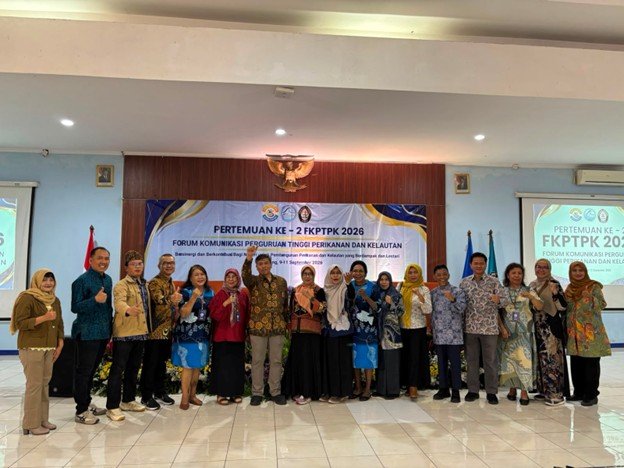
The Faculty of Fisheries and Marine Sciences (FPIK) of Universitas Muslim Indonesia (UMI) actively participated in the 2nd Forum of Indonesian Higher Education Institutions for Fisheries and Marine Sciences (FKPTPK) in 2026, held at Universitas Diponegoro (UNDIP), Semarang, from September 9–11, 2026.
The national forum was attended by approximately 300 participants representing 158 higher education institutions specializing in fisheries and marine sciences across Indonesia. The event served as a strategic platform to strengthen collaboration and institutional networks, align curriculum development with industry needs, and formulate concrete contributions from higher education institutions to the development of Indonesia’s fisheries and marine sectors.
The event was officially opened by the Rector of Universitas Diponegoro, represented by Vice Rector II for Planning, Finance, Assets, Business, and Household Affairs, Dr. Warsito Kawedar, S.E., M.Si., Akt.
Several strategic agendas were discussed during the meeting, including fisheries and marine science specialization areas, national recommendations for fisheries and marine development in Indonesia, collaboration networks to achieve Key Performance Indicators (IKU), nomenclature and academic degrees, the Body of Knowledge (BoK), curriculum agreements, organizational matters, and the election of the 2026–2028 leadership team.
Through a deliberative process, the formateur team unanimously agreed to appoint Prof. Agus Trianto, S.T., M.Sc., Ph.D., Dean of the Faculty of Fisheries and Marine Sciences at Universitas Diponegoro, as Chairman of FKPTPK for the 2026–2028 period.
Transforming Study Programs to Increase Student Interest
One of the main sessions focused on “Study Program Transformation to Increase Prospective Student Interest,” delivered by Prof. Dr. Sugiharto, S.Pt., M.Sc., Ph.D., Dean of the Faculty of Animal and Agricultural Sciences at UNDIP.
The session highlighted the importance of innovation in academic programs to make them increasingly adaptive to the evolving needs of society, the world of work, industry, and developments in the fisheries and marine sectors. Higher education institutions are expected not only to maintain the existence of their study programs but also to develop distinctive academic strengths and characteristics that are relevant and attractive to prospective students.
In addition, Prof. Dr. nat. tech. Siswo Sumardiono, S.T., M.T., Director of Academic Affairs at UNDIP, delivered a session entitled “Structuring an OBE-Based Curriculum: Ensuring the Achievement of Graduate Learning Outcomes through Systematic and Impactful Design.”
The discussion emphasized the importance of developing an Outcome-Based Education (OBE) curriculum with systematic alignment among graduate profiles, Graduate Learning Outcomes (CPL), areas of study, courses, learning processes, and assessment. In this way, the curriculum serves not merely as an administrative framework but as an effective instrument for producing graduates with competencies that meet the needs of society and the world of work.
Strengthening the Body of Knowledge of Higher Education Institutions in Fisheries and Marine Sciences
Another important agenda was the discussion on the Body of Knowledge (BoK), led by Prof. Dr. Ir. Endang Hilmi, SHut., M.Si., IPU., ASEAN Eng.
The BoK discussion was highly strategic as it relates to strengthening the academic identity and boundaries of fisheries and marine science disciplines. The agreed BoK is expected to serve as a foundation for curriculum development, areas of study, Graduate Learning Outcomes, courses, research, and the development of faculty expertise.
Higher education institutions are encouraged to develop a BoK that responds to advances in science and technology while addressing the real needs of Indonesia’s fisheries and marine sectors.
For FPIK UMI, strengthening the BoK is an important component of advancing fisheries education and scientific development, including strengthening the field of aquaculture, particularly to support the development of strategic national commodities such as shrimp, crab, lobster, tilapia, and seaweed. This also includes increasing the added value of fisheries products, promoting environmentally responsible fisheries, and strengthening exploration and research in marine sciences.
FPIK UMI Advocates for Increased National Shrimp Production
FPIK UMI specifically advocates for stronger contributions from higher education institutions toward increasing national shrimp production, considering shrimp as a strategic commodity that plays an important role in exports, community livelihoods, the processing industry, and employment opportunities, particularly for university graduates.
The forum also responded to the issue of shrimp imports, which may affect domestic shrimp prices and reduce the absorption capacity of the domestic processing industry. Therefore, shrimp import policies should prioritize national interests, the sustainability of domestic aquaculture businesses, industrial competitiveness, and biosecurity.
In this regard, the forum conveyed several key expectations and recommendations to the Government of the Republic of Indonesia, including:
- Stop Shrimp Imports and Prioritize Domestically Farmed Shrimp
Domestic shrimp aquaculture production remains capable of meeting the needs of the shrimp processing industry. Therefore, domestic production should be prioritized. - Conduct an Impact Assessment of Shrimp Imports and Stop Imports with Disease Risks
Findings of diseases or non-compliance with safety requirements should serve as the basis for temporarily suspending imports and conducting a comprehensive risk assessment. - Prevent Leakage into the Domestic Market
Strengthen supervision and monitoring to prevent imported shrimp from entering the domestic market through unauthorized or uncontrolled channels. - Establish a National Integrated Shrimp Data System
Develop unified and reliable national shrimp data to support evidence-based policymaking and strengthen the competitiveness of the domestic shrimp industry. - Involve Higher Education Institutions as Strategic Partners of the Government and Industry
Higher education institutions should be actively involved as strategic partners in research, technology development, policy studies, biosecurity, productivity enhancement, and strengthening the competitiveness of Indonesia’s national shrimp industry.