TAKALAR, FPIK UMI – The Faculty of Fisheries and Marine Science (FPIK), Universitas Muslim Indonesia (UMI), continues to contribute to the conservation of coastal and marine ecosystems through community engagement initiatives. One such effort was carried out through a training session and hands-on practice in seagrass ecosystem rehabilitation using transplantation techniques, involving active community participation on Satangnga Island, Tanakeke Islands District, Takalar Regency, on Sunday, October 11, 2026.
The activity, entitled “Seagrass Ecosystem Rehabilitation through Transplantation Based on Education and Community Participation on Satangnga Island, Takalar Regency,” was led by Dr. Ir. Hamsiah, M.Si., with Prof. Dr. Ir. Andi Asni, M.P., and Asmidar, S.Kel., M.Si., serving as team members. The initiative also involved students Muh. Arief, a master's student, and Muh. Nasir, an undergraduate student, as well as Eko Saputra, S.Kel., M.Si., an alumnus of the Master's Program in Coastal Management and Marine Technology, who served as the training instructor.
The program was conducted in partnership with the Jagad Samudera Community Group, chaired by Masriadi Dg. Tika. This collaboration represents an important step toward strengthening local community capacity and encouraging residents to take an active role in protecting and restoring coastal ecosystems in their area.
Improving Community Knowledge of Seagrass Rehabilitation
The head of the community service team, Dr. Ir. Hamsiah, M.Si., stated that members of the Jagad Samudera Community Group demonstrated great enthusiasm throughout the training. The activity provided participants with new knowledge and insights into seagrass ecosystem rehabilitation through transplantation, a technique that was previously less familiar to the local community.
According to Hamsiah, community members were more accustomed to transplantation techniques used in coral reef rehabilitation. Through this program, participants were introduced to seagrass rehabilitation methods, from learning about planting media to practicing transplantation techniques directly in the field.
“This training provides an opportunity for the community to learn seagrass transplantation techniques and understand how they can be applied directly in the field,” Hamsiah explained.
Education about seagrass ecosystems is particularly important because public understanding of their ecological functions and benefits still needs to be strengthened. One of the issues identified around Satangnga Island is the anchoring of boats over seagrass beds. Such activities can potentially damage seagrass cover and interfere with its growth if not properly managed.
This situation highlights the need for continued education, ecosystem protection, and rehabilitation efforts. Community involvement is essential to ensure that coastal areas can be used responsibly without compromising the sustainability of marine ecosystems.
The Important Role of Seagrass in Coastal Ecosystems
During the educational session, Hamsiah explained that seagrass ecosystems play strategic roles from both ecological and economic perspectives. Ecologically, seagrass helps reduce wave energy, stabilize sediments, and provide habitats and feeding grounds for various marine organisms.
The presence of seagrass ecosystems also supports coastal water productivity and the survival of numerous organisms that depend on these habitats.
Economically, seagrass ecosystems contribute to sustainable fisheries, provide environmental services, and offer potential opportunities for coastal tourism development. Therefore, protecting and rehabilitating seagrass beds should be an integral part of sustainable coastal management.
“Seagrass ecosystems provide a wide range of important ecological and economic benefits. Their sustainability must therefore be maintained through continuous management and rehabilitation efforts,” Hamsiah emphasized.
Transplantation Practice Using Environmentally Friendly Materials
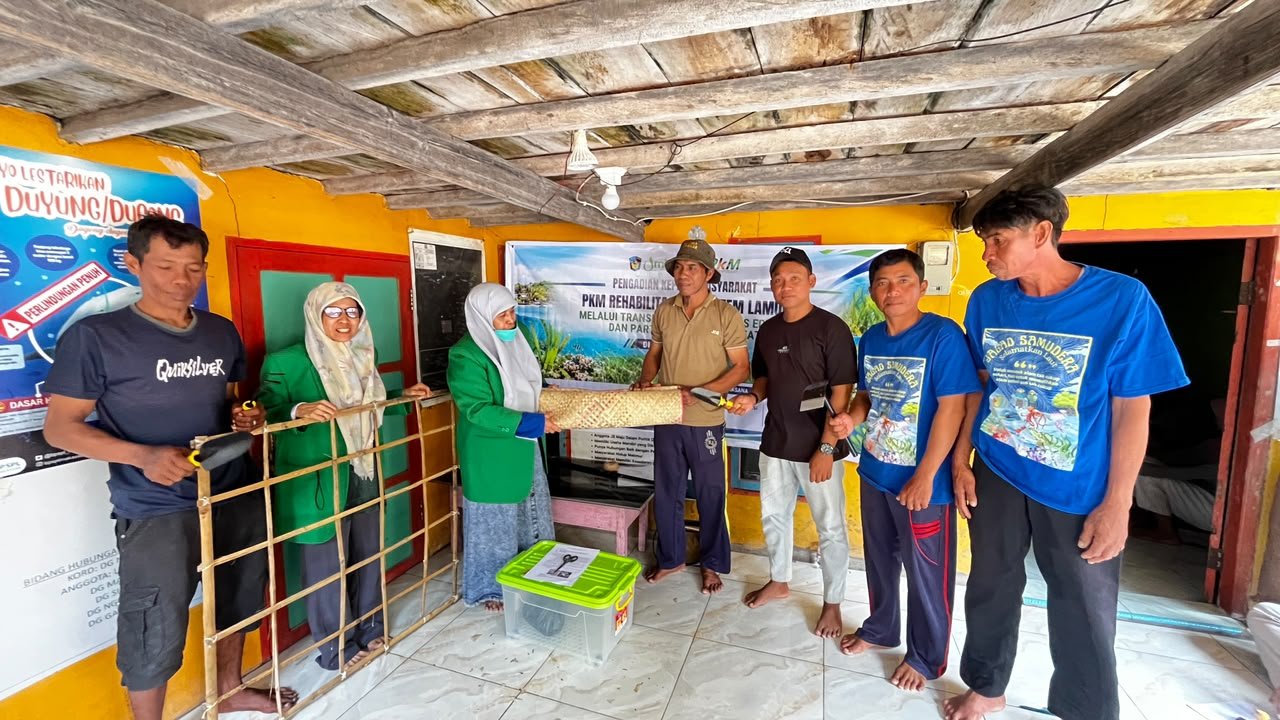
In addition to receiving educational materials, participants took part in demonstrations and hands-on practice in seagrass rehabilitation through transplantation. During the activity, the team introduced two types of planting media: bamboo frames and woven mats, which served as supports for the transplanted seagrass.
Training instructor Eko Saputra, S.Kel., M.Si., explained that these materials were selected because they are natural materials with the potential to decompose naturally in the environment. Coconut fiber rope was also used to secure the seagrass to the planting media as part of an effort to implement more environmentally friendly rehabilitation techniques.
Through this practical session, participants gained direct experience in identifying planting materials, understanding the transplantation process, and learning how rehabilitation techniques can be applied in the field. This hands-on approach is expected to help participants understand the methods introduced and provide them with practical knowledge to support future coastal ecosystem restoration initiatives.
Expanding Coastal Ecosystem Rehabilitation Efforts
The chair of the Jagad Samudera Community Group, Masriadi Dg. Tika, welcomed the implementation of the program. He explained that the group, established in 2013 at the initiative of the South Sulawesi Provincial Marine Affairs and Fisheries Agency, had been actively involved in mangrove forest rehabilitation. However, the group had not previously conducted rehabilitation activities involving coral reefs or seagrass ecosystems.
According to Masriadi, the training conducted in collaboration with the UMI community service team provided group members with new knowledge and experience, enabling them to expand the scope of their coastal ecosystem rehabilitation efforts.
“Through this activity, our group has gained new knowledge and experience that will help us expand coastal ecosystem rehabilitation efforts beyond mangroves to include seagrass ecosystems,” said Masriadi Dg. Tika.
This experience is expected to encourage the Jagad Samudera Community Group to become more actively involved in conserving various coastal ecosystems in accordance with the environmental needs and conditions of Satangnga Island.
A Commitment to the Three Pillars of Higher Education
The community service program represents UMI's contribution to implementing the Three Pillars of Higher Education (Tridarma Perguruan Tinggi), particularly community service. By applying scientific knowledge and practical skills directly in the community, the initiative seeks to address local needs while raising awareness of the importance of sustainable coastal and marine resource management.
An educational approach based on community participation serves as a strategy for fostering long-term environmental awareness. Beyond introducing transplantation techniques, the program also encourages residents to recognize the importance of protecting seagrass habitats and participating in their rehabilitation.
Through this initiative, FPIK UMI strengthens collaboration among lecturers, students, alumni, and community groups in supporting coastal ecosystem conservation. This partnership is expected to serve as an initial step toward developing sustainable seagrass rehabilitation efforts on Satangnga Island while reinforcing the role of higher education institutions in promoting responsible and sustainable marine environmental management.
FPIK UMI remains committed to advancing education, research, and community service initiatives that deliver tangible benefits to coastal communities and the environment.